Smart & Sustainable, Green Garden Design, Coaching & Seasonal Maintenance


Saturday, January 15, 2011

Roses in the Sacramento Valley - Part 2

Sally Holmes rose, at the Sacramento City Cemetery

Roses are beautiful and can help us to create gardens full of color and fragrance. According to the Sunset Western Garden Book, it's "undoubtedly the best-loved flower and most widely planted shrub in the West and all other terperate parts of the world." However, when you start learning about roses, it's easy to be washed overboard, and drown in the ... Sea of Too Much Information! If you're lucky, however, there's a Sunset Garden Book nearby!


Knowing what type of rose you're looking at will give you prediction on how often and when it will bloom and what kind of pruning and care it will need. This post will cover some basic info about the different types of roses, where to see roses, buy roses, learn about roses. The next, and last part of this series, will cover how to prune and care for your roses.

Here's a breakdown of the 6 major groups, caged from that book of books, my Sunset Garden Book.

Six Types of Roses

Modern Large-Flowered Roses (Hybrid Teas and Grandiflora): long-blooming rose, most cut roses sold by florists, great single flowers for cutting garden or the floral trade.. These have been developed by rose breeders to have a loooong blooming period with increasingly more and more disease resistance.
First Prize, my sister, Julie's pretty hybrid tea rose
Modern Landscape Roses (Floribunda, Polyanthas, shrub roses, hybrid musks, ground cover or carpet roses): these are roses that produce clusters of roses, rather than single roses, thereby creating a big landscape effect..
my neighbor's modern landscape-type rose coming into my yard, note the squirrel
Old Roses – any rose that existed before the 1st modern rose was introduced in 1867, either old European or Asian in origin. (Gallica, Noisettes, Tea, Alba, China roses, Hybrid perpetuals...whatever, the big thing, is they were there before the modern rose fiddling began in 1867. So, there)
Modern Climbing Roses (either natural climbers with large flowers or climbing sports of bush roses): – climbers have sturdy stems, ramblers grow long flexible stems yearly (often used on low fences), pillars are like climbers, but not as tall (frequently grown on a post or a pillar-like structure as a garden accent).
High Hand Nursery in Loomis using a row of rose arches to enclose the outdoor cafe
Miniature Roses -good for containers and window boxes or as ground-cover type plants. These are replicas of larger roses, grown to 1 - 1.5' tall.
Species Roses - (wild species roses) These are roses that have retained their originality, free from cross-breeding influence of other roses. One example is the Lady Banks Rose, Rosa banksiae, that you can see in full glory in the spring at the Sacramento City Cemetary.

Public Rose Gardens


Eglantine Avenue
One of the lovely lanes at the City Cemetery where you can see historic roses of all descriptions, with names like Grandmother's Hat and Hoffman von Fallersleben. There's also a perennial plant garden and a native plant section at the cemetery. It's a peaceful place. If you've never been there, I think you'll like it.


Shopping Places!

It's Bare-Root Season! While the roses aren't in bloom, they are inexpensive, and a lot of nurseries are having sales. Big box stores like Home Depot and Lowe's have bare-root roses in stock right now, but the independent nurseries have the best selection and the newest varieties. These nurseries will also have more established, larger, mature roses ... always nice if you want instant satisfaction! Many of these nurseries are offering pruning classes in January and  February, so you can ask questions and see how it's supposed to be done while you're there, SHOPPING!


Some Great Online Resources

A useful online tool for pictures, terms, trivia … www.helpmefind.com/rose.
Lifetime master gardener, 2 local gardening radio shows: meet The Professor, Farmer Fred (Hoffman) (Hint: while you're at it, check out his recommendations of the best 10 roses for Sacramento)
Rose Images A great source for pictures and information on roses!
Don’t let those roses be lonely…give them a few friends! Companion Plants for Roses
The Sacramento Rose Society - lots of info and links useful to us Valley folk


Buddy Up with Other Rose Lovers

My choice is the Sacramento Perennial Plant Club...which meets at the Sheppard Garden and Arts Center on the last Thursday of the month. This month's meeting includes a presentation on the Best David Austin Roses for Sacramento. But, there are lots of clubs and they're all happy to welcome new members and guests.

Want More? Here's the link to the other 2 parts of this series on roses in the Sacramento Valley: Part 1, an introduction, and Part 3, where we wrap it all up with a discussion of tools, terms, pruning techniques and the best way to keep your roses healthy and disease free. Hope this is useful in some way. Feel free to call me if you have any questions, or would like some in-your-garden help.


Call if you need some help with your rose pruning
Whether you need garden design, coaching, seasonal maintenance or planting, Geno's Garden can help!
Call me at (916) 764-5243, or email hansonja@aol.com.

Monday, January 10, 2011

Roses in the Sacramento Valley - Part 1

My dad was a backyard farmer, as was his father before him and my Irish great-grandfather before him (although he had an actual farm!). I remember my grampa’s deep, narrow lot in San Francisco where he grew corn. My dad grew asparagus and planted fruit trees and vegetables in Southern California, my mom canned. My brother and I sold avocados door to door. Small wonder I fancy gardening. It’s my heritage.
Golden Showers, a climbing rose
Golden Showers, my front porch climber (first introduced in 1957)

Now, farming is a highly practical activity … you grow something you can use at home or sell at the marketplace. It’s a straight-up activity. Gardening for fun, however, is another thing. My dad had strong opinions about roses … too hard, too fussy! Well, as I’ve become a more experienced gardener, I’ve found that this isn’t true. Sorry, Dad. Roses are actually quite hardy, having strong root systems that can keep them growing thru quite a bit of abuse. Treated smartly, they can be quite disease resistant. They are also incredibly beautiful and worth the effort to learn how to care for them.

Ballerina Rose
my Ballerina shrub rose, introduced in 1937

I think the thing that can throw a newcomer off is there is so much information and so much terminology! There are so many types of roses … old roses, miniature roses, carpet roses, climbers, shrub roses, ramblers …and it’s enough to really confuse a new gardener. As a garden coach I believe that success breeds success. Learn something about the subject, put it into action, watch what happens.

In the next week or so I'll be blogging about roses  ... we'll take a look at some of the basics, from pruning (which generally happens in January), to understanding the various types of roses and then we'll cover their general care.

Today's gardeners like to mix it up in their gardens, with ornamental plants like roses cozying up to an assortment of herbs and veggies. In my dad's day it was all vegetables-in-a-row, fruit trees in the orchard and a lawn in the front yard. Perhaps my dad's resistance to growing roses was in his day they were more disease prone. Could that be it? Certainly we have unlimited choices, and with today's online mailorder nurseries, easy access to it all. Whatever ... love my dad, love my roses. It's all good!


Want More? Here are the links to Parts 2, where we discuss types of roses, great rose retailers, public rose gardens and some useful online resources, and Part 3, where we wrap it all up with a discussion of tools, terms, pruning techniques and the best way to keep your roses healthy and disease free. Hope this is useful in some way. Feel free to call me if you have any questions, or would like some in-your-garden help.

Whether you need garden design, coaching, seasonal maintenance or planting, Geno's Garden can help!
Call me at (916) 764-5243, or email hansonja@aol.com.

Monday, January 03, 2011

California Incense Cedar


Flicker Photo Credit: col and tasha

Calocedrus decurrens - California Incense Cedar
Origin: Western Oregon to Baja, mountain ranges from elevations of 2500 - 4000'
Character: Upright, columnar to pyramidal evergreen tree. Solid structure when young, opens up with age. Dense with  a fine texture.
Growth Rate: moderate to rapid, up to 3' per year is common, ultimate height being 75 - 100' x 15 - 30'.
Foliage: medium to dark green scale-like needles form  flattened branchlets
Flowers, Fruits and Seeds: the Incense Cedar bears both male pollen flowers and small female cones.
Environmental Preferences: full to partial sun, regular moisture, partly drought tolerant because of deep tap root, needs good drainage
Uses: accent, screen, windbrake, lawn, shade, Christmas tree, cut foliage, furniture
Pests/Diseases: most problems come from poor drainage.
Propagation: seed, cuttings
Sunset Zones: 1-12. 14-24
Comments: wood prunings smell like pencils, attractive redish stems.


Whether you need garden design, coaching, seasonal maintenance or planting, Geno's Garden can help!
Call me at (916) 764-5243, or email hansonja@aol.com.

Wednesday, December 22, 2010

Sacramento's Favorite Tree - The Coast Redwood

Avenue of the Giants, Humboldt Redwood State Park in Northern California
Flickr photo credit: Jason Sturner 72

Sequoia sempervirens - Coast Redwood
Origin: native to Coast Ranges from southern Oregon to the central California coast
Character: One of the West's most famous native trees, and, the tallest tree in the world. Grows rapidly, up to 5 - 10'//year. Can reach up to 350', but in the landscape, more likely to top out at 70 - 90' x 15 - 30' wide. It is very upright and columnar, growing more open with age. Most have branches that grow horizontally, extending upwards at tips.
Foliage: needles are alternate along the branchlets, stiff and pointed, extending like feathers to either side. Generally deep green, grayish beneath.
Fruit, Seed and Flower Description: 1" fruits, both male and female flowers.
Environmental Preferences: full or partial sun, moderate to regular water, complete fertilizer in the spring
Pests and Diseases: almost entirely pest free; can be sensitive to iron tie-up or deficiency which causes yellowing Handled with iron phosphates or chelates.
Sunset Zones: 4-9, 14-24
Uses: accent, specimen tree, lawn, screen or windbreak (can be planted singly or in groves, 7'+ apart), utilitarian (lumber).
Comments:  Fire resistant. Some of its cultivars include, 'Aptos Blue' (dense blue-green foliage); 'Soquel' (finely textured needles); 'Los Altos' (very deep green, with a drooping, arching branches); 'Adpressa' (a dwarf redwood that grows up to 3' tall and 6' wide, nice for a rock garden)


Whether you need garden design, coaching, seasonal maintenance or planting, Geno's Garden can help!
Call me at (916) 764-5243, or email hansonja@aol.com.

Getting to Know Your Evergreen Trees

clockwise from upper left, CA State Capitol Xmas tree, Corado Blue Spruce, Old Town Sacramento Holiday tree, Sequoia sempervirens
Merry Christmas, Sacramento Style

Winter is a great time to get to know your evergreens. The deciduous trees have lost their leaves and no longer distract the eye with all those messy details, like, spring flowers and summer fruits and colorful leaves in the fall. Perhaps this can be the year when you stop calling all the trees remaining, "Pine Trees". The differences may not be as apparent as with their deciduous brethren, but they are there. And, while you may not be a "Hort Nut" (someone who is crazy about plants), it's wise to know some evergreen basics ... such as how tall and wide they'll get, and whether they like lots of sun. Knowledge is Power! Thus I'm starting a series of posts on the most popular/successful trees for the Sacramento Valley. Stay tuned!
Tonight: Sequoia sempervirens, aka, Coast Redwood.

Whether you need garden design, coaching, seasonal maintenance or planting, Geno's Garden can help!
Call me at (916) 764-5243, or email hansonja@aol.com.

Colorado Blue Spruce, a Sacramento Xmas Favorite

Picea pungens 'Glauca'
The Blue Spruce establishes the trim color for this Curtis Park home.

Picea pungens 'Glauca' - Colorado Blue Spruce
Origin: Rocky Mountains; Wyoming, Utah, Colorado and New Mexico
Character: this evergreen tree is naturally shapely, requiring little pruning. It is dense, solid and upright with a  pyrimidal to conical shape.
Growth Habit/Size:grows rather slowly, but extremely long-lived. In a garden setting, it's more likely to be 20' -30' at maturity, and 1/3 as wide. In the wild it can 3 times as tall.
Foliage: stiff needles ("pungens" = sharp) grow alternately or spiraled around the entire branch ... the blue of the needles comes from a film or cast that can be rubbed off to reveal it's base green color ("glauca" = film).
Fruit, Seed and Flower Description: spruce cones are typically 4" long and "pendant" or hanging.
Environmental Preferences: moist to somewhat dry soil preferred, with full to partial sun and neutral to slightly acidic soil.
Pests/Diseases: can have problems with aphids (look for small, dull green aphids in the winter, and treat to prevent defoliation in the spring).
Uses: specimen, accent, common as living Christmas tree, some useage for cut foliage. 
Sunset Zones: 1/10, 14-171 - 10, and 14 - 17.
Propagation: semi-hardwood and hardwood cuttings.
Comments: the Colorado Spruce is probably the best of the spruces for the Sacramento Valley. It has many interesting cultivars in the 'Glauca' category, including, 'Fat Albert', which grows to 10' - 15' x 10' x 12', making it a nice size for the suburban landscape, and 'Pendula', the Weeping Blue Spruce, which can grow as a ground cover or trained into a small weeping tree. These evergreens can be grown in a container, which will keep their roots from going deep, and thus will need a cooler environment so they don't dry out.
 
a blue spruce bonsai 

Whether you need garden design, coaching, seasonal maintenance or planting, Geno's Garden can help!
Call me at (916) 764-5243, or email hansonja@aol.com.

Wednesday, December 15, 2010

Last Call: Fall-Planted Bulbs

I love the expression, "last call", makes me want to work in a bar and holler it out! Other than that (ahem) it's time to plant the spring-blooming bulbs. They're ready to go to work! Here are some choices:

daffodil bulbs
These big bags of daffs are such a bargain. Plant them about 6" deep. Now.
(Read more about daffs here)

Scilla
Commonly known as squill or bluebells, scilla are a bit iffy for our zone, preferring a colder winter. I suspect this one is S. siberica.

Crocus vernus
Plant these crocus for a quick reward of color ... per Sunset's Western Garden Book, the flowers will appear in days to weeks after planting!

a little bulb ready to go to work!
This muscari bulb needs some moisture from the soil to really fire up that little shoot.

Hyacinthoides hispanica
Spanish Bluebells blooming last April at the WPA Rock Garden in William Land Park. Gorgeous, and they like us!

Other bulbs that you can plant now, include aliums (ornamental onions), lily-of-the-valley, freesia, fritallaria, iris and the cute snowflakes with the green dot on each petal(leucojum). It's late in the game to be ordering from bulb companies, so see what the nurseries have on their racks.

What else can be planted, now that you're in the mood? Snapdragons, violas, pansies, primrose, cyclamen... take a look around the nurseries and see what's available, most anything you find will work. Nurseries stock up for the season at hand. While you're at it, throw some California Poppy seeds out there ...
Eschscholzia californica
Our own state flower was a great choice for California ... sunny, boldly colored, hardy, prolific, just like us!

If you'd like some help getting those bulbs planted, let me know, I'm available to help you or some lucky person who picks you for the gift exchange! Whether you need garden design, coaching, seasonal maintenance or planting, Geno's Garden can help!
Call me at (916) 764-5243, or email hansonja@aol.com.

Thursday, December 09, 2010

Plant Now for Spring Daffodils

Flickr photo credit: PresleyJesus

Narcissus species, Daffodil. Narcissus, Jonquil
Origin: Europe and North Africa
Character: somewhat open clump.
Growth Habit/Size: typically up to 18", with flower up to 24". Are permanent and increase from year to year. If clumps get too large, they should be divided so that they will continue to be productive (otherwise too much competition for space and food and start dying out.)
Leaf and Flower Description: leaves are strap-like and fleshy to the touch. You can usually feel the mid-rib. Can have a variety of color combinations with the 2 main parts of the flower. Bulbs are 2 - 3" in diameter, tapering at the shoot end ("this end up"). Plant 5 - 6" deep and best planted after weather cools off in the fall.
Environmental Preferences: preferably full sun while blooming, not fussy about soil, Do not need summer watering.
Sunset Zones: all 
Propagation: division
Comments: Daffodils produce vegetative growth in the winter and flower in late winter or early spring. Spent flowers can be cut back, but leaves should be allowed to die back before removal so they can do their job of replenishing the bulb's food supply for the next year. Feed after flowering, not before (or may just get green leaves and no flowers). Deer (supposedly) do not like daffodils.

Whether you need garden design, coaching, seasonal maintenance or planting, Geno's Garden can help!
Call me at (916) 764-5243, or email hansonja@aol.com.

Wednesday, December 08, 2010

Wordless Wednesday: Olive Dreams

17 June, 2010
Congratulations on winning your own olive tree adoption in our Nudo/Ready Made competition. Enjoy the fruits of your tree! Love, Nudo

my adoption certificate comes in the mail, my grove is Rosalio, my olive, a leccino, my tree is 39 years old


my 3 flavored olive oils arrived in mid-November


I think I've getting an idea...


parking lot olive tree ... who wants those olives?


not all the olives ripen at same time


I already have a link to how to make these beauties, and it's Christmastime, when I make stuff...


will she, or won't she?


To read more about olive trees and the harvesting of olives: Olive Trees for the Sacramento Valley


Besides the eating of good olives - yum! - my biggest delight is including olive trees in landscapes with other mediterranean or native plants. So much better than a boring lawn, don't you think?
Whether you need garden design, coaching, seasonal maintenance or planting, Geno's Garden can help! Call me at (916) 764-5243, or email hansonja@aol.com.

Sunday, December 05, 2010

Olive Trees for the Sacramento Valley


Olea europaea, Olive Tree
Origin: Mediterranean
Character: mounding rounded head, usually multi-trunked. Natural form has branches to the ground. Billowy look, not real open.
Growth Habit/Size: moderate,  grows to 30' x 30'. Olives can live 1000+ years and will have buttressed trunks with age.
Uses: accent, specimen tree, utility (olives). Give a sense of place to the California landscape.
Leaf & Flower Description: foliage is opposite along branches, elliptical to linear in form. The dark glossy green or grayish and tomentose leaves are approx. 2 - 3" x 1/2". Leaf margins cup downwards. Small, whitish flowers in the spring become the olive fruit in the fall.
Environmental Preferences: hardy, take heat, aridity, and drought to regular water. Tolerates rather than prefers a residential environment.
Cold Hardiness: hardy, Sunset zones 8-9, 11-24  
Pests/Diseases: scale, thrips
Propagation: tip cuttings
Comments: Fair Oaks, Placerville, Orangevale and Carmichael at one time were heavy olive producers, so they are often found in local landscapes. Can be a definite mess with seed drop which can also stain. Can be treated to reduce flowering, but this is not 100% effective. Treat when you see bees pollinating the flowers.There are also varieties that are (nearly) fruitless, such as, Swan Hill, Majestic Beauty, Wilsoni and Little Ollie. Field-dug mature trees are available for landscapes that require an established look immediately.
A Word About Olives: olives are bitter and inedible straight from the tree and need to be either water-cured or lye-cured (instructions courtesy of the Boorinakis-Harper Ranch in Auburn). To learn more about the science and industry of olives, visit the UC Davis Olive Center.


Whether you need garden design, coaching, seasonal maintenance or planting, Geno's Garden can help!
Call me at (916) 764-5243, or email hansonja@aol.com.

Friday, December 03, 2010

Eat Your Vegetables! (A Yummy Kabocha Squash Soup)


My daughter, Liesel, had this soup at the new Ten 22 Restaurant in Old Sacramento last weekend. It was lovely and they gave me the recipe. I think the seasoning amounts were wrong ... so I adjusted them as shown in my video, but the originals are listed in this link: Ten 22's Kabocha Squash Soup.
I also found a website that took that old Kabocha and ran with it. All the recipes looked great, so here's another link, this time to Healthy Chow.

Also, since I do love dem seeds, here's a link about how to save those seeds for next year's garden.


Whether you need garden design, coaching, seasonal maintenance or planting, Geno's Garden can help!
Call me at (916) 764-5243, or email hansonja@aol.com.

Wednesday, December 01, 2010

A Wordless Wednesday

What did I do today? A bit of shopping, a bit of planting and a bit of looking at the sky ...

daffs, crocus, alium, primrose, etc.

Sacramento clouds

Sacramento sunset


Whether you need garden design, coaching, seasonal maintenance or planting, Geno's Garden can help!
Call me at (916) 764-5243, or email hansonja@aol.com.

Monday, November 29, 2010

Great Tree for Sacramento Landscapes


Koelreuteria paniculata, California Rain Tree
Origin: China, Japan
Character: slightly open structure, with a broad, dome-shaped canopy.
Growth Habit: moderate fast, grows to 35' by 30 - 35'
Uses: accent, lawn tree, shade tree, street tree
Description: eliptically shaped leaves are pinately compound, with leaflets approx 1 - 2" and entire leaf, 12". The compound leaves are alternately arranged on branches. The margins are coarsely serrated. Medium dark leaves turn yellow-orange in the fall. Large showy yellow panicles in the early to midsummer are followed by red - buff papery seed capsules in the fall.
Environmental Preferences: Prefers moist soil, and partial/filtered  to full sun.. Can take drought once established, smog, heat, wind and seacoast conditions.
Cold Hardiness: hardy, Sunset zones 2 - 21
Propagation: seed, semi-hardwood cuttings
Comments: deep roots make this a good choice for planting in a lawn or as a street tree, while fall color and showy flowers make it a great accent tree. This tree is available thru the Sacramento Tree Foundation.


Whether you need garden design, coaching, seasonal maintenance or planting, Geno's Garden can help!
Call me at (916) 764-5243, or email hansonja@aol.com.


Sunday, November 28, 2010

Plant Profile: Cyclamen

Question: Whose root looks like a beet, goes dormant (i.e., looks dead) in summer and produces colorful blooms thru the winter?
cyclamen for sale at High Hand Nursery in Loomis, CA
Answer: It's the plant of the week, Cyclamen!

Cyclamens are welcome in the winter garden, bringing a lot of color, especially when densely planted. They're easy to clean up if you've got a mind for it. Just give a tug to the spent flowers and, voila, they'll look like this cyclamen bowl I tidied up just before snapping the shot.
a closeup of cyclamen at Home Depot
I created a partial shade, evergreen border once that I was particularly fond of ... cyclamen mixed with maidenhair fern (Adiantum capillus-veneris) and the smaller, low-growing azaleas ('Gumpo' series). Also put in some Heuchera sanguinea, the old-fashioned coral bells with their rosy flowers nodding atop upright stems.


Whether you need garden design, coaching, seasonal maintenance or planting, Geno's Garden can help!
Call me at (916) 764-5243, or email hansonja@aol.com.


Friday, November 12, 2010

Book Review: The New Book of Salvias; Sages for Every Garden by Betsy Clebsch

"Clebsch is the Salvia Queen ... If you love salvias, this is the book for you." - Seattle Times
The New Book of Salvias

I was first introduced to Betsy Clebsch at the Perennial Plant Association annual meeting held in Sacramento in 2004. It was obvious by her reception by this professional group of horticulturists, that she was, “The Salvia Expert”. I was there on an academic scholarship. I was presented with a plaque and written up in the newspaper (ahem). What a thrill it was to rub elbows with book editors, nursery owners and cell tissue plant propagators. I thought everyone was an expert, and they probably were.

Fast forward to 2010 ... I have fallen in love with salvias, but the relationship hasn’t always been successful. I’ve killed off a few of my beaus, some more than once (sorry Salvia guaranitica 'Black and Blue'). I’m ready to learn.

The book is divided into 3 sections, opening with Betsy's essay on salvias ... her personal experiences growing salvias in her own gardens and a broad view that will give the motivated student a good practical base of information.
“Gardening has been a thread pulled tight throughout my life, a steady interest that binds the pages that follow. I have made and tended five gardens, the first in Virginia, the second in Texas, the following three in California. In my second California garden the handsome evergreen foliage and striking foliage of many distinctly different salvias led me to grow them. This garden was a country retreat, and several weeks would frequently pass between visits. Plants had to be sturdy and plants had to be able to survive with irregular care and water.
In selecting plants to be described in this book, I have chosen those that are, in my experience, both beautiful and interesting garden subjects. Each salvia I describe can be grown well if you have some practical cultural information, and they will thrive for some time if you nurture them. Obviously, some salvias are not appropriate  for specific gardens because of temperature range, light patterns, or soil conditions.”
The majority of this book (283 pages out of the total 344) is then devoted to describing the characteristics and requirements of each of the 150 featured species, with additional recommendations on companion planting and bits of plant gossip … which hummingbirds frequent this or that plant, which are bee magnets and which are simply, fussy. These descriptions are augmented with color photos and sketches.

The closing charts are wonderfully practical ... the seasonal bloomers, the drought tolerant species, which salvias tolerate shade, those that can handle humidity and of huge interest to this Californian, which are native to my home state and which are water-wise.

This is a book that will be referred to often. As Betsy says, "Salvias have such diverse expectations, this is the book one needs to be successful."

The New Book of Salvias: Sages for Every Garden by Betsy Clebsch (Timber Press; 2nd edition - April 15, 2008)


Some of my favorite salvias are the ones that bloom in late fall. Gotta love a plant that brightens the November garden! Whether you need garden design, coaching, seasonal maintenance or planting, Geno's Garden can help!
Call me at (916) 764-5243, or email hansonja@aol.com.


Wednesday, November 10, 2010

Re-Discovering Yourself At Rancho La Puerta

sunset at Rancho La Puerta
This September I spent a week at Rancho La Puerta in Tecate, Mexico. My sister, Julie, had been there numerous times and always raved about it. I had never been to a spa, I was curious, but somehow had an attitude … it would be a week of self-indulgence, not really my thing. But, she invited me to go with her and I went, and found myself touched in profound ways. In addition to lovely food, dance, art and cooking classes (and those spa treatments!), I walked and walked and walked. I looked at the plants and the sky and the hills. And, I breathed. On the Rancho La Puerta website, it says, “We provide space – that which is most lacking in today’s life. Space to breathe freely amidst nature. To relax. To renew, reflect and redirect one's longer-living life. To explore the possibilities of changing course in one's life.”

One of my favorite classes was with visiting artist, Erin Galfill, of Big Sur, CA.


(you might also like this earlier post about Erin's class, Te Recuerdo, Rancho La Puerta)


I think the success of the Ranch is that guests come to discover themselves newly. What makes them happy, who they are when they’re happy. We’re all unique, so this experience is unique as well. Me, I discovered space and the smell of sage. I also re-discovered the joy of moving to music in a hardwood-floored, sunlight-steaming-in-thru-the-windows dance studio or salsa-ing the night away on Friday night with the marvelous Rancho La Puerta band.


Want to create some cheer for our darker season with some cool season bedding plants? How 'bout putting some daffodils underground so they will be brightening your February garden as only they can? Holiday gifts from the garden or for your favorite gardener ... good idea, but what???? Whether you need garden design, coaching, seasonal maintenance or planting, Geno's Garden can help!
Call me at (916) 764-5243, or email hansonja@aol.com.


Wednesday, October 27, 2010

Halloween: It's That Time Again!

Liesel Hanson
Seems to me, somebody was partying a bit too hard last night ...

Yup, it's that time of year to dress up and get ghoulish! Or, if something a bit more sedate is your pleasure, there's a  Fall Festival happening this Saturday from 8 am to 1 pm at the Davis Farmers Market, featuring:
  • Live Music by Music Matt, the Peter Franklin Band
  • Davis Farm to School's Avenue of the Scarecrows
  • Kid's Activities, including "Pet the Baby Piggies"
  • Farm-fresh Pizza and Harvest Pie-by-the-Slice
  • Plant Sale and Free Flower Seeds
  • ...and as always, the happy, healthy, (w)holesome products offered twice weekly at the market, organic fruits and vegetable, locally produced cheeses, honey, olive oils and the like, even (MEAT)!


To find out more, visit the Davis Farmers Market on the web. And, make sure you go while they're open ... last weekend my husband and I got there 1 hour after they closed. yea.


Whether you need garden design, coaching, seasonal maintenance or planting, Geno's Garden can help!
Call me at (916) 764-5243, or email hansonja@aol.com.

Wednesday, October 06, 2010

Plant Profile: Tulbaghia violacea, Society Garlic

Tulbaghia violocea, a Flickr photo by IngaMun

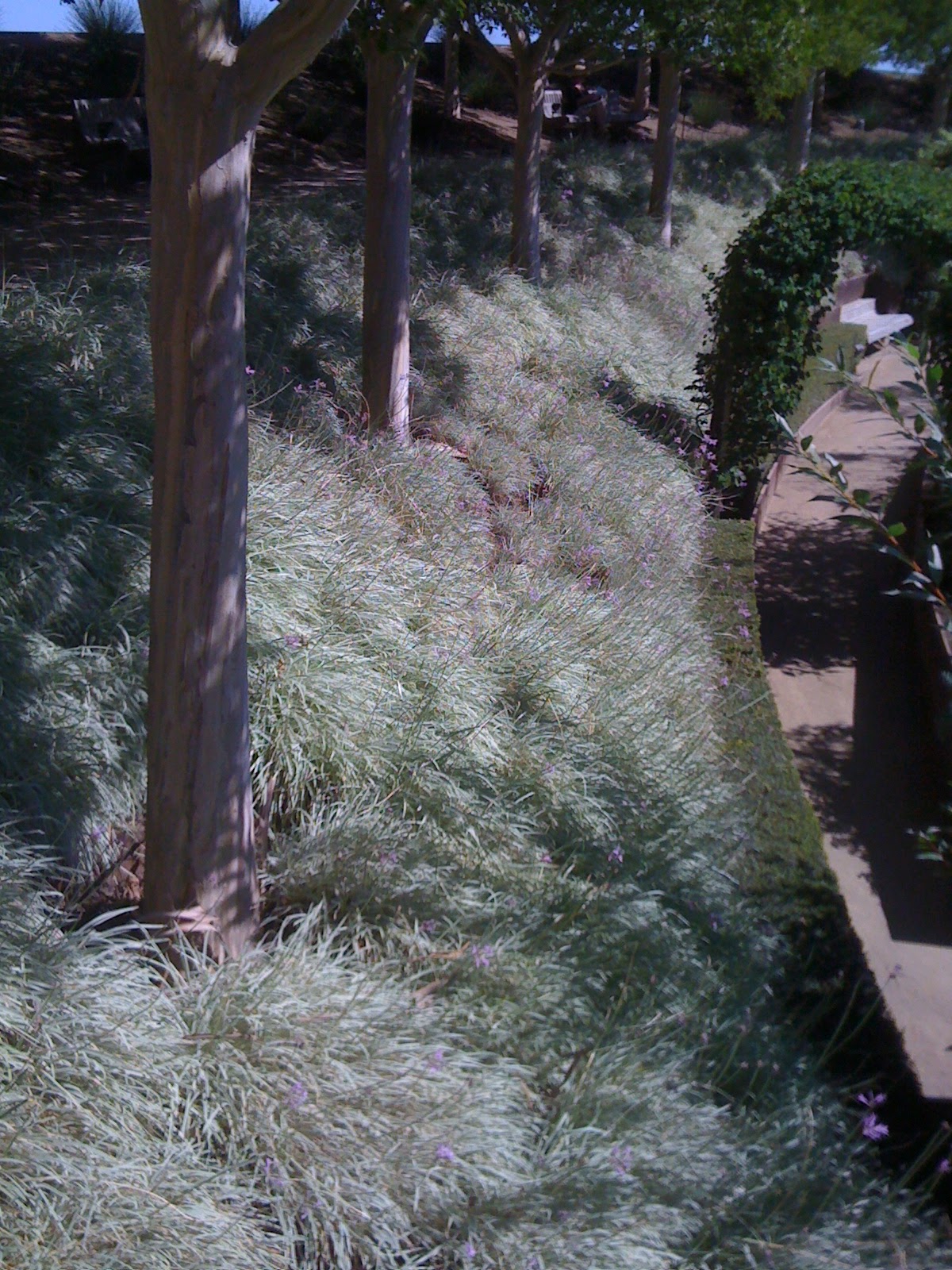
A South African native, society garlic is a garden trooper! You probably won't find it on many lists of favorite plants, and yet it looks good and flowers for an incredibly long time! It does have a smell of onion or garlic, but that doesn't deter me from admiring this easy plant. It looks fine without maintenance (deadheading spent flowers) from a distance, but will look fresher up close and produce more new flowering shoots with a wee bit of TLC.
Dense clumps of straight, narrow, evergreen leaves send up slim, 1 - 2 ft. stems  topped by clusters of small, trumpet-shaped, pinkish lavender flowers Suffer frost damage at 20 - 25 degrees F, but recover quickly. Start plants from containers or divisions at any time (though early spring or early fall is best in hot-summer areas). (Sunset Western Garden)
While the flowers are the same color, its evergreen leaves are available in a few different colors, the main one being green, my favorite being, 'Variagata', which has a white stripe down its middle.


One of my favorite uses of society garlic is in a big planting, like in this garden at the Getty Center in August,
Tulbaghia violacea, 'Silver Lace'


or, this bed with the cool sculpture at the Rancho La Puerta in September
Tulbaghia violcea, the green one


society garlic clipped to ground in the winter
A buzz cut in the winter keeps this Starbuck's bed of society garlic and fortnight lily behaving (mostly for the benefit of the fortnight lily, which can get downright ratty if allowed to run rampant!) ...


the border rebounds!
... and, here they are at the end of June.


Try this in your garden and I think you'll find your thumb feeling a bit greener!


Whether you need garden design, coaching, seasonal maintenance or planting, Geno's Garden can help!
Call me at (916) 764-5243, or email hansonja@aol.com.

Friday, October 01, 2010

Te Recuerdo, Rancho La Puerta, September, 2010

my villa in the morning mist

I just returned from a wonderful week at Baja Mexico's Rancho La Puerta, which is celebrating it's 70th anniversary this year and was deservedly voted Travel and Liesure Magazine's 2010 "World's Best Destination Spa." They have many activities one can take part in. I'm so glad I took an art class with the wonderful, Big Sur artist, Erin Gafill! She had us do an exercise to awaken our creativity:

Close your eyes and recall the Ranch, then write down your impressions, starting with "I remember..."


I remember sage - silver and gray sage,

Salvia leucophylla, Gray Sage


and the light and shadow of the plants as they form a community.

Salvia apiana, White Sage


I remember mountains surrounding the ranch, with sunlight...

the hills west of the ranch


and rocks forming groupings,


and yellows and ochres and buffs.

I love this sculpture


And the meadows...

Gaillardia and an old cart

and the quiet.

sculptures and art are found throughout the Ranch


My sister, Julie, organized this trip. A former travel agency owner and now a social media coach and strategist for businesses, she brought along, as well, 7 other wonderful bloggers. It was a pleasure getting to know them, as well as the many other staff, guests and guest presenters we met at the Ranch.

I have more to say, and I shall (!), but I don't want to hog the conversation. What do you remember?


Whether you need garden design, coaching, seasonal maintenance or planting, Geno's Garden can help!
Call me at (916) 764-5243, or email hansonja@aol.com.